
LE-TRA Is Ending. Your Next Move Matters
The phase-out is coming soon, planning now saves cost, confusion, and disruption later in your SAP Transportation Management Migration journey.
2030 Feels Distant—Until You Realise What’s at Stake.
On December 31, 2030 LE-TRA will phase out, and the LE-TRA to SAP TM migration takes time. You need to make a prompt decision right now to avoid the chaos afterwards during your SAP Logistics Execution Migration.
Critical Deadline Approaches
SAP ECC 6.0 Maintenance Ends
Deadline: 31 Dec, 2027
LE-TRA Rights of Use Removed from S/4 HANA
Deadline: 31 Dec, 2030
Redefine Your Transportation Future with NAV IT
This isn’t just a tech switch, it’s about keeping business running. NAV-IT supports every step SAP LE-TRA to SAP TM Migration.
Current Situation Assessment
Strategic Planning Phase
Meticulous Execution Phase
Dedicated Change Management
Post-Migration Support
Custom In-House Solutions
Don't let your tech be your bottleneck
Benefits of Migrating from LE-TRA
A Future-Ready Transportation Platform
Every journey starts by understanding exactly where you are today. We dive deep into your existing SAP LE-TRA and SAP Logistics Execution setup and daily struggles to find the real bottlenecks during the SAP LE-TRA to SAP TM Migration. This isn’t a one-size-fits-all plan; it’s a custom strategy designed to align your technology with your actual business goals through a structured SAP Transportation Management Migration and SAP TM Implementation.
Smarter Planning, Lower Freight Costs
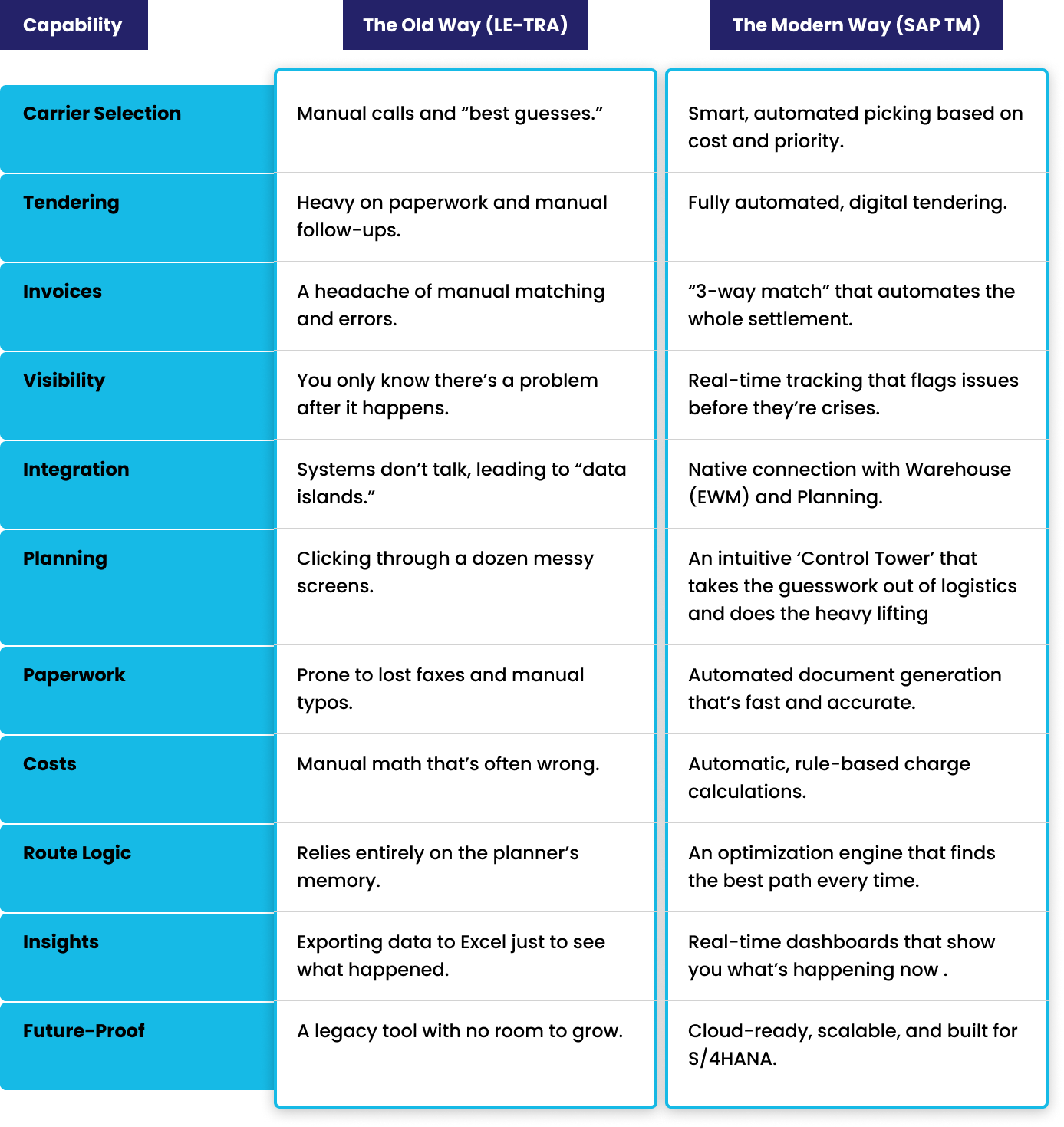
Right now, planning probably involves a lot of “gut feelings” or manual spreadsheets, which is where money leaks out of the budget in SAP LE-TRA transportation processes. SAP TM, as part of the SAP LE-TRA to SAP TM Migration, takes that weight off your shoulders. It uses automation within SAP Transportation Management to look at every possible route and carrier, picking the one that makes the most sense for your bottom line. You stop overpaying for freight because the SAP TM implementation identifies cost-saving opportunities that legacy SAP Logistics Execution systems and manual planning usually miss.
Faster and More Efficient Operations
Nobody likes clicking through a dozen different screens just to move one shipment. SAP TM cleans up that mess with a single “cockpit” view. It’s automation capacity increases the throughput, so your team spends less time fighting the software and more time actually managing the warehouse. It turns a clunky, slow process into something that feels fast and responsive.
Real-Time Visibility Across Shipments
There is nothing worse than having a customer ask where their order is and not having a clear answer. LE-TRA’s tracking is pretty basic, but SAP TM gives you the “where and when” in real-time. You know immediately if a shipment is stuck or delayed. This gives you time to fix the delays before things go haywire
Stronger Carrier Collaboration
If your team is buried in emails and phone calls just to get a quote or a status update, you’re losing time. SAP TM moves all that back-and-forth into a digital portal. It’s a cleaner way to work that carriers actually appreciate. When you make it easy for them to work with you, you become a “shipper of choice,” which is a huge advantage when truck capacity gets tight.
Integration Across the SAP Landscape
The biggest headache in logistics is when the warehouse doesn’t know what the transport team is doing. SAP TM fixes that by talking directly to EWM (Warehouse) and IBP (Planning). It creates one single flow of information. No more double-entering data or dealing with human-made errors between departments, everything finally just works together.
SAP LE-TRA vs SAP TM
Break free from legacy. Scale without limits
Any Industry That Moves Goods Will Feel the Shift already
Manufacturing, logistics providers, retail, automotive, pharmaceuticals, food supply chains, if transportation is part of your operations, this sunset affects you.

Top 5 LE-TRA Migration Challenges and How to Overcome Them
Most companies don’t plan an LE-TRA migration because they want

LE-TRA to SAP TM Migration – A Comprehensive Guide
For many organizations running SAP ECC, transportation has quietly relied

Top 5 LE-TRA Migration Challenges and How to Overcome Them
Most companies don’t plan an LE-TRA migration because they want

LE-TRA to SAP TM Migration – A Comprehensive Guide
For many organizations running SAP ECC, transportation has quietly relied
Related Blogs

Top 5 LE-TRA Migration Challenges and How to Overcome Them
Most companies don’t plan an LE-TRA migration because they want

LE-TRA to SAP TM Migration – A Comprehensive Guide
For many organizations running SAP ECC, transportation has quietly relied

What Are the Key Differences Between LE-TRA vs SAP TM?
Transportation systems tend to fade into the background when they
FAQs
Why are companies moving away from SAP LE-TRA?
SAP LE-TRA is in maintenance mode and no longer evolving. While it served execution needs in the past, modern logistics now demands real-time visibility, carrier integration, appointment scheduling, automation, and AI-driven capabilities. LE-TRA cannot support these requirements, which is why SAP TM has become the strategic transportation platform going forward, accelerating the industry shift toward LE-TRA to SAP TM migration.
Is SAP TM mandatory if we are moving to S/4HANA?
Yes, if transportation functionality is required. LE-TRA is not fully embedded in S/4HANA, whereas SAP TM (Basic and Advanced) is part of SAP’s future roadmap. For long-term scalability, innovation, and support, LE-TRA to SAP TM migration is recommended, as SAP TM is the supported and strategic transportation platform going forward.
What’s the difference between LE-TRA and SAP TM?
LE-TRA is limited to execution-only processes with no real-time visibility, limited carrier collaboration, manual freight costing, no appointment scheduling, and no analytics. SAP TM goes far beyond execution by enabling planning, optimization, visibility, automation, collaboration, and data-driven decision-making, making LE-TRA to SAP TM migration essential for modern and scalable transportation management.
How long does a typical SAP TM migration take?
The timeline depends on scope. A Basic TM implementation typically takes three to five months, Advanced TM takes six to twelve months, and projects that include full visibility and AI applications can take eight to fourteen months. Reusability accelerators can significantly reduce these timelines as part of a well-planned LE-TRA to SAP TM migration.
What data needs to be migrated from LE-TRA?
Commonly migrated data includes freight agreements and rate tables, carrier master data and routes, freight cost rules, organizational structures, and reference documents such as deliveries and transportation orders. Historical shipment data is migrated only if business requirements demand it.
Will our existing carriers and warehouse partners be impacted?
Yes—positively. SAP TM enables better collaboration through digital tendering, automated event updates, appointment scheduling, and faster dispute resolution. Most partners experience improvements with no major operational disruptions.
Do we need all SAP TM modules at once?
No. Organizations can start with Execution and Settlement using Basic TM and gradually expand. Planning, optimization, BN4L integration, dock and gate control through Orion, real-time tracking via SKY and SKY Plus, invoice automation with Pluto Invoice, and conversational updates through Pluto Chatbot can be added as needed. SAP TM is modular and expandable.
What are the biggest challenges during migration?
Typical challenges include understanding TM’s complex master data, carrier onboarding and integration, data cleansing, designing new planning and charge rules, and managing organizational change and training. With the right approach and accelerators, these challenges become manageable.
How do we ensure end-to-end logistics visibility after moving to TM?
This is where NAV IT’s plug-and-play AI solutions add significant value. Pluto BOL enables procurement and inbound visibility, Orion manages gate-in/gate-out and dock appointments, SKY and SKY Plus provide real-time road and ocean tracking, Pluto Invoice automates carrier invoice validation, and Pluto Chatbot delivers quick shipment updates through conversational AI. Together with TM and BN4L, this creates a full logistics control tower.
What ROI can we expect after adopting SAP TM?
Customers typically see ROI within three to nine months through better route optimization, reduced freight costs, lower demurrage and detention, reduced manual effort, faster invoice settlement, improved OTIF performance, and real-time visibility that minimizes exceptions.
Will SAP TM replace all of LE-TRA’s functionality?
Yes—and more. Everything LE-TRA supported is available in SAP TM, along with added layers of intelligence, automation, visibility, and network collaboration.
Do we need BN4L for SAP TM?
BN4L is not mandatory but highly recommended. It enables real-time tracking, digital document exchange, carrier collaboration, and appointment handling. TM combined with BN4L and NAV IT’s AI solutions delivers world-class logistics visibility.
How does NAV IT support the migration?
NAV IT supports migration through prebuilt TM templates, BN4L onboarding accelerators, plug-and-play visibility apps, AI-powered invoice automation via Pluto Invoice, gate automation with Orion, road and ocean tracking through SKY and SKY Plus, procurement visibility using Pluto BOL, and chat-based shipment insights with Pluto Chatbot. This ensures a complete end-to-end transformation, not just a system migration.